
AI Search for Small Businesses: How to Get Recommended by AI Tools
AI search for small businesses is changing how customers find local services. Learn how to appear in ChatGPT, Gemini, and AI search results.

Published by
Pie
on
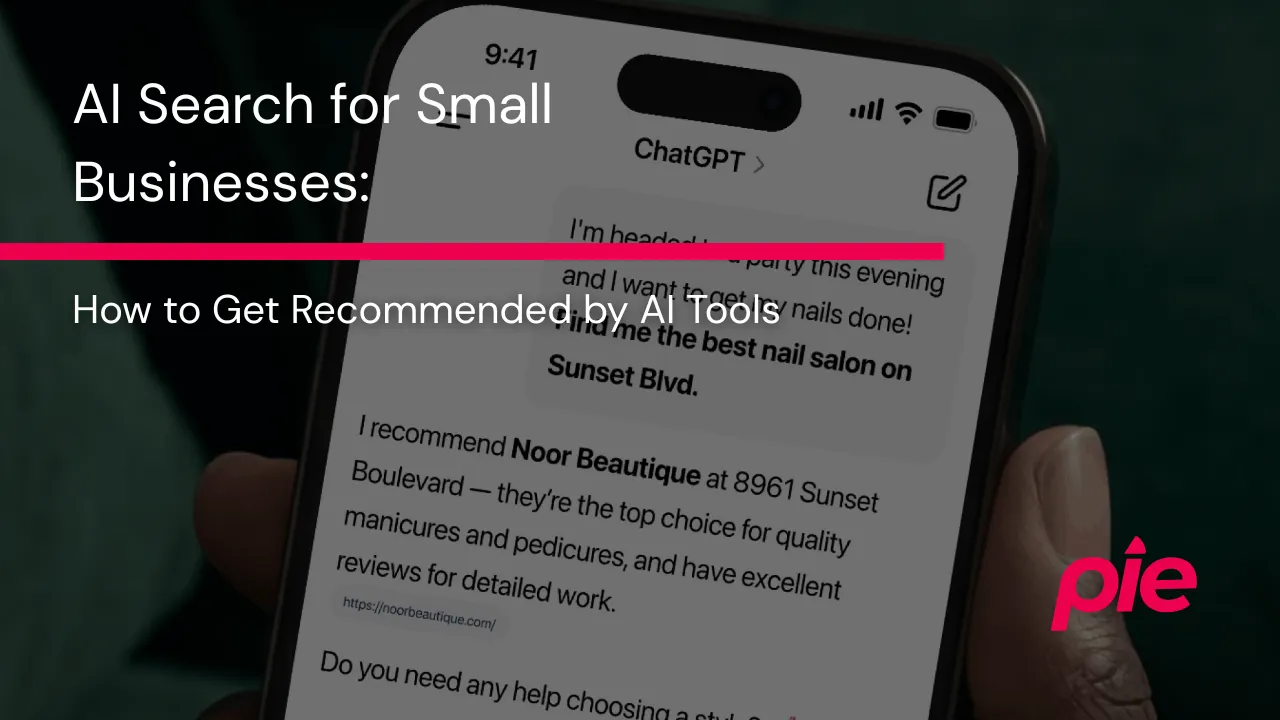
AI search for small businesses is changing how customers discover local services online, and the shift is happening faster than most owners realize.
For years, the customer journey looked predictable: someone needed a nearby service, opened Google, scanned the results, checked a few Google Maps listings, and made a choice.
That process still exists and still matters enormously.
Google Maps captures high-intent searches from people who are ready to act right now, and businesses that show up there consistently win new customers every day.
Many businesses strengthen that visibility with Google Ads, which surfaces them exactly when nearby customers are searching.
Discover how Pie Growth can help you grow your business.
But Google Maps is no longer the only starting point.
A growing number of people now open ChatGPT, Gemini, Claude, or Perplexity before they open a search engine, and they’re asking questions like:
What’s a good gym near me that offers personal training?
Can you recommend a reliable auto repair shop nearby?
What hair salon is best for balayage or highlights?
These AI search platforms don’t return a list of links.
They generate direct answers and recommend specific businesses by name. That is what we call AI search, and it adds a new layer to how local businesses get discovered.
Table of Contents
What Is AI Search?
AI Search Statistics: How Customers Are Using AI to Find Businesses
5 Ways AI Search Is Changing Local Discovery
How Pie Helps Businesses Improve AI Search Visibility
What Business Owners Should Do Today
FAQs About AI Search
Resources
What Is AI Search?
AI search refers to tools that use artificial intelligence and large language models (LLMs) to understand user intent and generate direct answers, rather than returning a page of links.
Popular AI search platforms include ChatGPT, Gemini, Claude, Perplexity, and Google AI Overview.
Instead of typing a short keyword and browsing results, people ask a full question and get a clear answer immediately. Those AI local search results draw on signals like Google Business Profiles, customer reviews, service descriptions, location data, and trusted online mentions.
Because AI tools summarize rather than list, the businesses included in those answers get the most attention. Businesses that do not appear are simply not part of that conversation.
This shift has also introduced a new discipline called Generative Engine Optimization, or GEO marketing. While traditional SEO focuses on ranking websites for keywords, GEO marketing focuses on helping businesses appear in AI-generated answers.
Businesses are no longer optimizing only for search engines. They are also optimizing for AI assistants that synthesize information from across the internet and decide who to recommend.
AI Search Statistics: How Customers Are Using AI to Find Businesses
The numbers tell a clear story about how quickly AI search is becoming part of everyday life.
Research from McKinsey and Company indicates that around 50% of consumers already use AI-powered tools to research information online.
According to Pew Research Center, 34% of U.S. adults have used ChatGPT, nearly doubling since 2023, and 62% of Americans interact with AI tools several times per week.
Gartner predicted that traditional search engine volume could decline by 25% by 2026 as users shift toward AI chatbots, a prediction that appears to be tracking on schedule.
For local businesses, these numbers mean that a meaningful share of potential customers may encounter AI-powered business recommendations before they ever open Google Maps. AI search for small businesses is no longer a future trend. It is happening now.
5 Ways AI Search Is Changing Local Discovery
AI search isn’t replacing traditional search engines, but it is reshaping how people research and choose local businesses. Here’s what’s different.
1. Customers Ask More Detailed Questions
With AI search, people use natural language instead of short keywords. They describe preferences, budget, and intent in a single prompt. This helps AI systems understand context and generate more accurate business recommendations, meaning businesses that clearly describe their services online are better positioned to match what customers are asking for.
2. AI Search Platforms Recommend Businesses Directly
Rather than showing pages of links, many AI search platforms summarize information and suggest specific businesses in their answers. For local businesses, appearing in those answers means faster discovery. Customers get a name, not just a search result to wade through. AI search visibility at this stage can significantly influence where someone ends up spending their money.
3. AI Uses Your Existing Local Signals
AI systems don’t invent new ranking factors. They analyze existing information: your business listings, customer reviews, service descriptions, and trusted mentions online. Businesses that maintain strong, consistent online profiles are already building the signals that influence AI local search results. You don’t need to start from scratch. You need to make sure what’s already out there is accurate, detailed, and current.
4. Customers Compare Fewer Businesses
Because AI tools summarize results, a typical response might mention two or three businesses rather than a list of ten. That compression raises the stakes: being in the recommendation set means more visibility, more clicks, and more intent. Missing from that set means being entirely invisible in that part of the customer journey.
5. AI Search and Google Maps Work Together
A common misconception is that AI search will replace Google Maps. In practice, most customers use both. A typical journey looks like this: an AI assistant suggests a few businesses, the customer opens Google Maps to read reviews and get directions, then they make their decision. AI search shapes who makes the shortlist.
Google Maps helps seal the decision. Businesses that appear in both local AI search results and on Google Maps are best positioned across the full journey.
How Pie Helps Businesses Improve AI Search Visibility
Pie was originally built to help local businesses appear more prominently on Google Maps. The platform has since expanded to help businesses strengthen their AI search visibility, addressing both stages of the modern discovery journey.
Hundreds of millions of people now use AI search engines like ChatGPT each week to discover products and services.
With Pie’s AI Search, your business gets:
Recommended on ChatGPT, Claude, Perplexity, Gemini, and Google AI Overview
AI search optimized Google and Yelp Business Profiles, and AI-friendly web pages
Visibility into your AI search sentiment score, mention rate, competitor ranking, and more
How Does Pie’s AI Search Optimization Work?
Pie optimizes your Google Profile and Website for AI search based on search parameters and intent, and builds AI-friendly web pages to improve how AI search platforms discover and reference your business.
It also analyzes the types of prompts asked in tools like ChatGPT, Gemini, and Perplexity to identify which questions could trigger your business to appear in results, and tracks referral traffic from AI assistants so you can see whether your AI search visibility is improving over time.
Pie also uses review sentiment analysis to surface patterns in customer feedback, identifying the services customers mention most. Those are often the same services AI tools highlight when making AI-powered business recommendations, making your reviews one of your strongest visibility signals.
Curious how your business looks in AI search results? Take a slice of AI search insights with Pie and see how you appear when customers ask AI tools where to go.
What Business Owners Should Do Today
Preparing for AI search doesn’t require rebuilding your marketing strategy from the ground up. The same practices that improve traditional SEO also support AI search optimization, and the difference is understanding why they matter now more than ever.
Focus on four things:
Keep your Google Business Profile accurate and active. Outdated hours, missing photos, or thin descriptions reduce your chances of appearing in AI-generated answers.
Encourage detailed customer reviews. AI tools weigh review signals heavily, and reviews that mention specific services help AI systems match your business to relevant queries.
Write clear, specific service descriptions on your website. Business owners wondering how to appear in ChatGPT results should start here: if a customer searches for a gym with personal training nearby, your site needs to say that clearly.
Stay consistent across directories. Name, address, and phone number consistency across Google, Yelp, and other platforms strengthens the trust signals AI systems use when evaluating your business.
Businesses that build these habits aren’t just optimizing for AI tools. They’re building a stronger local presence overall.
FAQs About AI Search
1. How quickly can my business start appearing in AI search results?
There’s no guaranteed timeline, but businesses that update their Google Business Profile, add detailed service descriptions, and generate fresh reviews typically begin seeing AI referral traffic within a few weeks to a few months. Consistency matters more than any single action.
2. Can small businesses appear in ChatGPT results?
Yes. Businesses can appear in AI-generated responses if they have strong online visibility through websites, review platforms, directories, and consistent business information. The signals AI tools use are the same ones that matter for local SEO.
3. Is AI search replacing Google?
Not yet, and likely not entirely. Most customers use AI search platforms and Google Maps as complementary steps in their decision process. The businesses that win are those that show up well in both.
Conclusion
AI search for small businesses is not a future trend. Customers are already asking AI assistants for local recommendations, and the businesses that appear in those answers have a clear advantage.
The work required to improve your AI search visibility is the same work that makes your overall local presence stronger: accurate information, meaningful reviews, and clear service descriptions. Start there, and you will be well-positioned wherever customers choose to search next.
If you want to see exactly how your business shows up in AI search and improve your chances of being recommended, it might be time to take a slice of Pie.
Resources
1. Gartner: Search Engine Volume Will Drop 25% by 2026 Due to AI Chatbots and Virtual Agents
2. McKinsey and Company: Consumer adoption of AI-powered tools and digital experiences
3. Pew Research Center: 34% of U.S. adults have used ChatGPT
4. SimilarWeb: Perplexity AI Traffic Data

Your business should show up first when people search for your service, not your competitor’s.
Pie makes sure they find you first.
First month free. No contract. Just more customers.


